
Fleetbase: Free Open Source Alternative to Onfleet for Fleet & Delivery Management

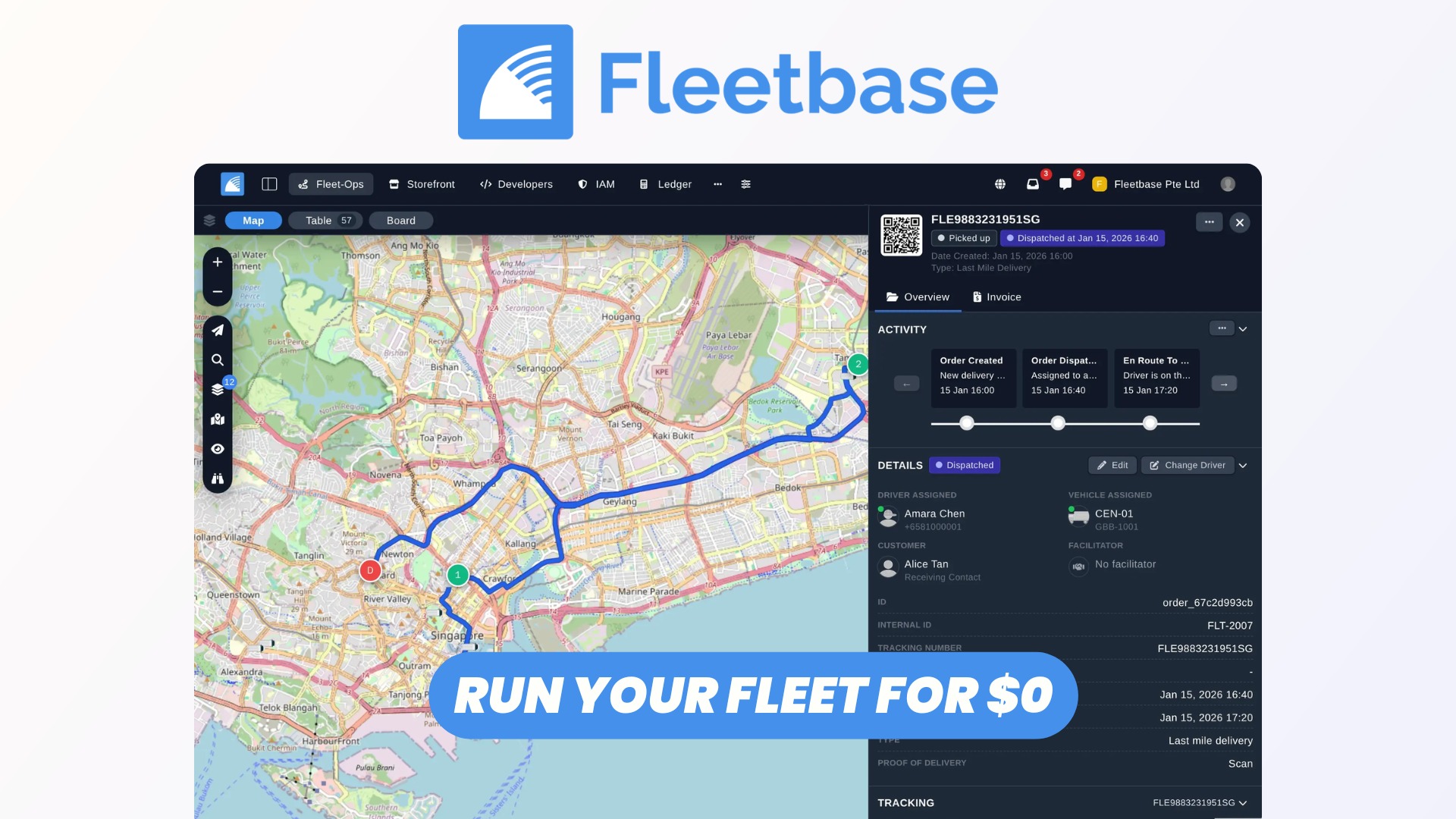
Managing deliveries, tracking drivers, optimizing routes, and coordinating fleets can quickly become complicated as a business grows. While platforms like Onfleet offer powerful delivery management capabilities, businesses looking for more flexibility, customization, and control over their infrastructure may prefer an open-source solution.
Fleetbase is a free, open-source logistics and fleet management platform designed to help businesses organize their transportation and delivery operations from a centralized interface.
From managing drivers and vehicles to tracking orders, optimizing routes, and creating online storefronts, Fleetbase provides a comprehensive ecosystem for logistics operations.
In this article, we'll explore Fleetbase's main features, how its different modules work together, and why it can be an interesting alternative to proprietary fleet and delivery management platforms like Onfleet.
Watch our platform overview
Drivers, Vehicles, & Fleets
One of the core components of Fleetbase is Fleet-Ops, its fleet management and dispatching module.
Fleet-Ops provides a centralized environment for managing the resources involved in your logistics operations, including drivers, vehicles, and fleets.
Driver Management
Fleetbase allows businesses to create and manage driver profiles, making it easier to organize their workforce and coordinate deliveries.
Instead of relying on spreadsheets or disconnected tools, dispatchers can manage driver information directly within the platform.
Driver management helps businesses:
- Maintain centralized driver records.
- Organize drivers across different operational teams.
- Assign drivers to delivery orders.
- Monitor driver locations and delivery activity.
- Coordinate dispatch operations more efficiently.
This is particularly useful for businesses managing multiple delivery drivers who need to coordinate their activities throughout the day.
Vehicle Management
In addition to drivers, Fleetbase provides tools for organizing the vehicles used in transportation and delivery operations.
Businesses can maintain vehicle records and associate vehicles with their logistics resources.
Centralizing vehicle information makes it easier to understand which transportation resources are available and how they are organized.
Whether you're managing motorcycles for food delivery, vans for local distribution, or trucks for larger transportation operations, Fleetbase provides a flexible foundation for managing your fleet.
Fleet Organization
For businesses operating multiple teams or groups of vehicles, Fleetbase also supports fleet organization.
Fleets help structure transportation resources into manageable groups, making dispatching and coordination more practical as operations expand.
For example, a logistics company could organize its vehicles and drivers into different fleets based on geographic regions, delivery services, or operational responsibilities.
By combining driver, vehicle, and fleet management, Fleetbase helps businesses maintain a clearer overview of their logistics resources.
Orders, Customers, Route Tracking & Optimization
Beyond fleet organization, Fleetbase provides tools for managing the entire delivery workflow, from creating orders to monitoring their progress.
Order Management
Orders are at the center of delivery operations.
Fleetbase allows dispatchers to create and manage transportation or delivery orders through its Fleet-Ops interface.
Orders can contain information about pickup and delivery locations, customer details, and the resources assigned to fulfill them.
This centralized approach allows businesses to:
- Create and organize delivery orders.
- Associate orders with customers and destinations.
- Assign delivery tasks to drivers.
- Track order progress.
- Coordinate pickups and drop-offs.
Rather than switching between multiple applications, dispatchers can manage their delivery operations from a single platform.
Customer Management
Fleetbase also helps businesses organize customer information alongside their delivery operations.
Maintaining customer records in the same system as delivery orders makes it easier to coordinate recurring deliveries and associate orders with the appropriate recipients.
This can be particularly valuable for courier companies, local delivery services, and businesses handling frequent customer orders.
Real-Time Route Tracking
Visibility is essential for efficient delivery management.
Fleetbase supports real-time driver tracking, allowing dispatchers to monitor field operations through a map-based interface.
Instead of contacting drivers individually to request updates, operators can use location information to better understand where their drivers are and how deliveries are progressing.
This helps businesses respond to operational changes, coordinate assignments, and improve delivery visibility.
Real-time tracking is especially valuable when managing multiple drivers across different locations.
Route Optimization
Another important feature of Fleetbase is route optimization.
When drivers need to complete multiple deliveries, choosing an efficient route can help reduce unnecessary travel and improve overall operational efficiency.
Fleetbase includes route optimization capabilities within Fleet-Ops to help businesses plan delivery routes.
Combined with order management and real-time tracking, these tools provide dispatchers with greater control over their transportation operations.
For companies looking for an open-source alternative to Onfleet, the combination of dispatching, tracking, and route optimization makes Fleetbase particularly interesting.
Navigator (Driver Mobile App)
Fleet management doesn't stop at the dispatcher's dashboard.
Drivers also need access to delivery information while they're on the road.
Fleetbase's Navigator mobile application is designed to connect drivers with their assigned delivery operations.
Rather than relying exclusively on phone calls or messaging applications, drivers can use a dedicated mobile interface to interact with their delivery tasks.
Navigator is intended to support the operational workflow between dispatchers and drivers, including accessing assigned orders, navigating to destinations, and updating delivery progress.
This connection between the management platform and the driver's mobile experience helps businesses keep field operations synchronized with their dispatching system.
For delivery businesses, having a dedicated driver application is an important part of building a more structured and scalable workflow.
Storefront (Online Store) & API
Fleetbase goes beyond traditional fleet management by offering additional modules that extend its capabilities.
One of the most interesting is Storefront, which connects online ordering with logistics operations.
Storefront: Online Ordering and Delivery
Storefront is Fleetbase's headless e-commerce and multi-vendor marketplace engine.
It provides the backend foundation for building online ordering experiences that connect directly with delivery operations.
For example, businesses can use Storefront as part of a platform for:
- Local food ordering and delivery.
- Grocery delivery services.
- Multi-vendor marketplaces.
- Retail ordering and local fulfillment.
- Hyperlocal delivery platforms.
One of its main advantages is its integration with Fleet-Ops.
Orders created through a Storefront-powered application can flow into the logistics system for dispatching and delivery management.
This makes Fleetbase more than a standalone dispatching tool: it can serve as the foundation for an integrated ordering and delivery ecosystem.
Because Storefront is headless, developers can build customized customer-facing interfaces while using Fleetbase to manage the underlying ordering and logistics processes.
API and Integrations
Another important advantage of Fleetbase is its extensibility.
Fleetbase provides developer-oriented capabilities, including APIs, webhooks, and event-based integrations.
These features allow businesses to connect Fleetbase with other applications and automate parts of their logistics workflows.
For example, developers can build integrations that:
- Create delivery orders from an external application.
- Connect logistics workflows with an existing e-commerce platform.
- React to delivery-related events through webhooks.
- Synchronize operational data with internal systems.
- Build custom applications around Fleetbase's capabilities.
Fleetbase also provides a Developer Console for managing API keys, webhooks, request logs, and system events.
This flexibility is particularly useful for companies that want their logistics management software to integrate with an existing technology stack rather than operate as an isolated system.
Custom Dashboards
Every logistics business has different operational priorities.
A local courier company may focus on active deliveries and driver availability, while a larger transportation business may need visibility across several operational teams.
Fleetbase supports customizable dashboards and widgets, allowing users to organize their workspace around relevant operational information.
Instead of relying entirely on a fixed interface, businesses can create dashboards better suited to their workflows.
Depending on the modules and widgets configured, dashboards can help teams access information related to orders, fleet operations, and other operational activities.
Fleetbase's modular architecture also allows businesses to extend the platform with additional functionality.
This is one of the advantages of an open-source logistics system: businesses can adapt the platform to their requirements instead of being limited to a completely predefined software experience.
Documentation
Fleetbase provides extensive documentation for users, administrators, and developers.
The official documentation covers the platform's architecture, deployment, configuration, and different modules.
It also includes resources for:
- Installing and deploying Fleetbase.
- Configuring the platform and user permissions.
- Working with Fleet-Ops and Storefront.
- Managing API keys and webhooks.
- Configuring dashboards and custom fields.
- Developing integrations and extensions.
For developers interested in customizing Fleetbase or connecting it with other systems, the documentation is an important resource.
You can explore the official documentation here:
Fleetbase Official Documentation
Conclusion
Fleetbase is a powerful open-source platform for businesses looking to manage fleets, drivers, orders, and delivery operations without relying entirely on proprietary logistics software.
Its Fleet-Ops module provides essential functionality for dispatching, driver tracking, and route optimization, while Navigator extends delivery workflows to drivers on the road.
With additional capabilities such as Storefront, APIs, and customizable dashboards, Fleetbase can also serve as the foundation for more advanced logistics and delivery platforms.
Compared with Onfleet, Fleetbase stands out through its open-source architecture, self-hosting capabilities, and extensibility. However, businesses should evaluate the specific features and operational workflows they require before choosing between the two platforms.
While Fleetbase is free and open source, self-hosting still involves infrastructure, deployment, security, and maintenance responsibilities.
For businesses that want to benefit from Fleetbase without managing the infrastructure themselves, Elestio offers a fully managed hosting solution.
With Elestio, you can deploy Fleetbase in minutes and benefit from automated backups, SSL certificates, monitoring, and infrastructure maintenance.
This allows you to focus on managing your logistics operations rather than maintaining the underlying servers.
Ready to try Fleetbase?
Deploy Fleetbase on Elestio and discover how an open-source fleet and delivery management platform can support your business.