
Hermes Agent: Free Open Source Self-Hosted AI Agent with Memory & Multi-Platform Gateway

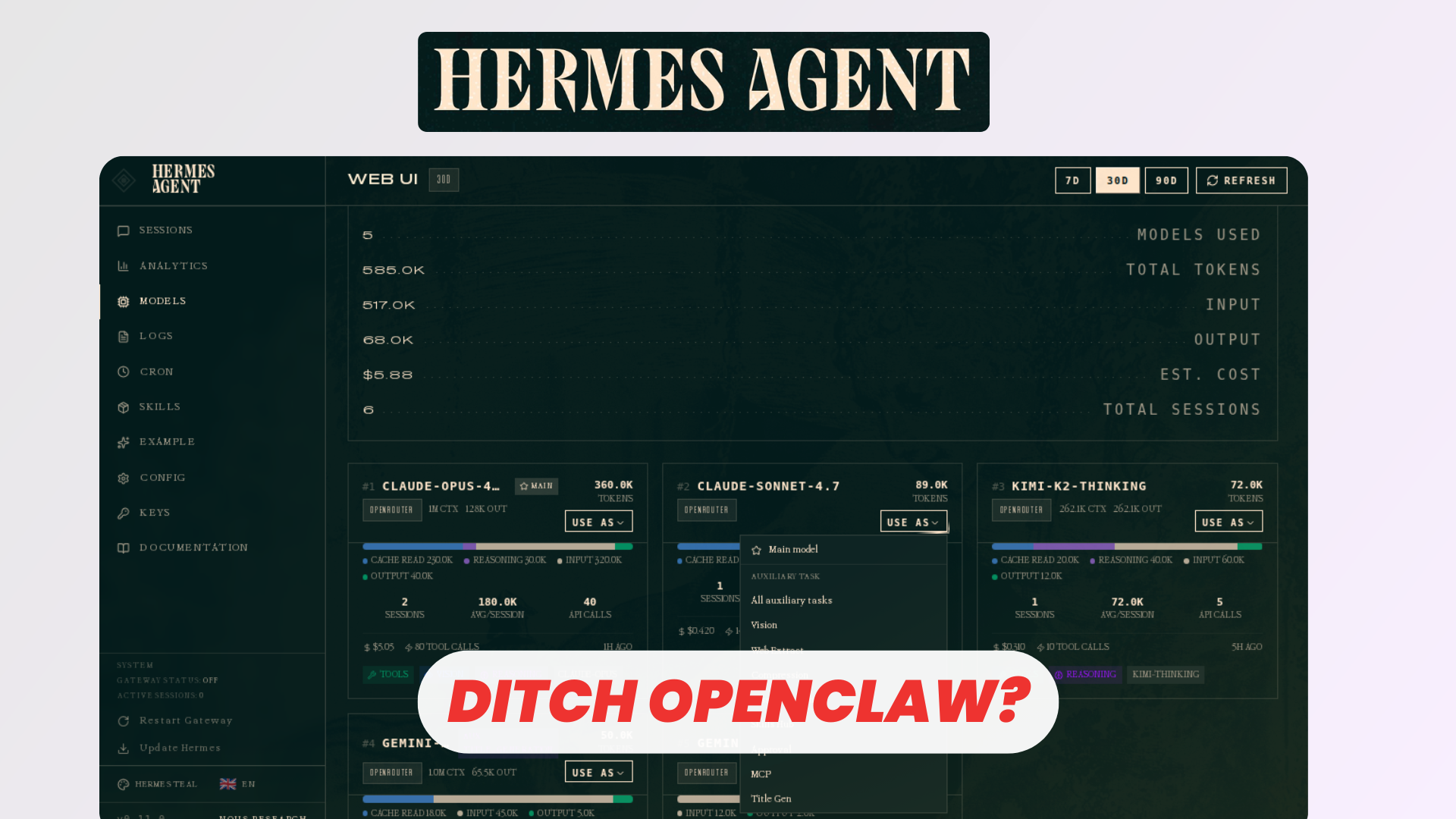
As AI agents continue evolving from simple chatbots into autonomous digital coworkers, developers and businesses are increasingly looking for platforms that combine flexibility, privacy, extensibility, and full infrastructure ownership. Many existing solutions rely heavily on cloud services, proprietary ecosystems, or expensive SaaS pricing models that become difficult to scale or customize.
Hermes Agent positions itself as a free and open source self-hosted AI agent platform designed for modern workflows. It combines long-term memory, multi-platform messaging gateways, project management, scheduled automations, skills, and collaborative tooling into a unified system.
Rather than acting as a single-purpose chatbot, Hermes Agent aims to become a persistent operational AI layer capable of interacting across multiple channels while maintaining context, tasks, and organizational knowledge.
In this article, we explore the major components that make Hermes Agent a compelling self-hosted AI infrastructure platform.
Watch our platform overview
LLM Providers
One of the strongest aspects of Hermes Agent is its provider flexibility.
Instead of locking users into a single model vendor, Hermes Agent supports multiple LLM providers, allowing developers to choose the balance between performance, privacy, cost, and deployment architecture.
Typical integrations may include:
- OpenAI-compatible APIs
- Local models through Ollama
- Anthropic Claude
- Google Gemini
- OpenRouter
- Self-hosted inference servers
- Custom endpoints
This provider abstraction makes the platform adaptable for both personal homelab deployments and enterprise-grade infrastructures.
For teams concerned about privacy or API costs, running local models through tools like Ollama becomes particularly attractive. Meanwhile, organizations requiring state-of-the-art reasoning can still connect premium cloud-based models.
The ability to dynamically switch providers also simplifies experimentation and benchmarking between models.
Admin UI
Hermes Agent includes a centralized administration interface designed to simplify operational management.
The Admin UI allows administrators to configure:
- LLM providers
- Messaging gateways
- Agent permissions
- Scheduled jobs
- Skills and tools
- Monitoring systems
- User access
- Project spaces
Instead of requiring manual configuration files or terminal-only workflows, the dashboard provides a much more accessible operational experience.
This becomes especially important in collaborative environments where non-technical team members may need to manage agents, workflows, or integrations.
The interface transforms Hermes Agent from a developer-only framework into a practical operational platform.
Profiles / Agents
Hermes Agent supports the creation of multiple AI profiles or specialized agents.
Each agent can maintain its own:
- Personality
- Prompt configuration
- Tool access
- Memory scope
- Model selection
- Behavioral rules
- Workspace permissions
This architecture enables organizations to create highly specialized AI coworkers.
Examples include:
- Customer support agents
- Internal knowledge assistants
- Technical DevOps agents
- Research assistants
- Content generation agents
- Sales assistants
- Project coordinators
Instead of relying on one monolithic AI assistant, Hermes Agent encourages modular AI systems optimized for distinct responsibilities.
Advanced Chat Interface
The chat interface goes beyond standard conversational UI patterns.
Hermes Agent focuses on maintaining persistent operational context while supporting advanced interactions such as:
- File attachments
- Rich conversation history
- Context-aware memory
- Tool execution
- Multi-agent interactions
- Threaded discussions
- Long-running sessions
The interface is designed for productivity rather than casual conversation alone.
This is particularly useful for workflows involving iterative collaboration, ongoing projects, or task-oriented operations where contextual continuity matters significantly.
Sessions / Projects
Hermes Agent introduces the concept of persistent sessions and project workspaces.
Rather than treating every interaction as an isolated chat, sessions can group:
- Conversations
- Tasks
- Documents
- Context memory
- Agent activities
- Files and resources
Projects allow users to organize operational workflows into logical environments.
For example:
- A software development project
- A marketing campaign
- A research initiative
- A client workspace
- A startup operations dashboard
This structure significantly improves context retention and long-term collaboration between humans and AI agents.
Messaging Gateways
One of the platform’s most powerful capabilities is its multi-platform gateway architecture.
Hermes Agent can potentially connect AI agents to multiple communication ecosystems, including:
- Discord
- Slack
- Telegram
- Email systems
- Web chat
- Internal enterprise communication tools
This enables agents to operate where users already communicate instead of forcing teams into a dedicated application.
A single AI agent can therefore become accessible across multiple channels while preserving centralized memory and operational state.
This gateway-based architecture is especially valuable for businesses seeking omnichannel AI operations.
Skills
Hermes Agent extends functionality through modular skills.
Skills act as capabilities or executable tools that agents can invoke dynamically.
Examples may include:
- Web search
- File processing
- Database queries
- API integrations
- Calendar operations
- Email automation
- Code execution
- CRM interactions
- Knowledge retrieval
This transforms Hermes Agent from a conversational platform into an action-oriented AI system capable of interacting with real operational infrastructure.
The modular approach also makes the ecosystem extensible for developers building custom integrations.
Scheduled Jobs
Automation is another critical component of Hermes Agent.
Scheduled jobs allow agents to execute tasks automatically at predefined intervals.
Examples include:
- Daily summaries
- Monitoring alerts
- Automated reporting
- Data synchronization
- Inbox processing
- Scheduled research tasks
- Reminder systems
- Background maintenance operations
By combining AI reasoning with recurring execution, Hermes Agent moves toward autonomous operational workflows rather than reactive chat-only interactions.
This makes it particularly attractive for internal automation systems and AI operations infrastructure.
Project Management / Kanban
Hermes Agent also integrates project management capabilities directly into the platform.
Kanban-style workflows help organize:
- Tasks
- Objectives
- Tickets
- Work stages
- Priorities
- Team collaboration
Integrating project management with AI agents creates interesting possibilities where agents can:
- Update tasks automatically
- Generate summaries
- Assist planning
- Track progress
- Organize documentation
- Coordinate workflows
This convergence between AI systems and operational project tooling represents an emerging trend in AI-native productivity platforms.
Task List / Cowork
The cowork-oriented task system further expands collaborative workflows.
Instead of treating AI as an isolated assistant, Hermes Agent positions agents as active participants in operational environments.
Task lists can support:
- Human assignments
- AI-generated subtasks
- Shared collaboration
- Progress tracking
- Workflow coordination
This model allows AI agents to function more like digital coworkers embedded inside organizational processes.
The result is a hybrid workflow where humans and AI systems collaboratively manage operational execution.
Monitoring UI
Operating autonomous AI systems requires visibility and observability.
Hermes Agent includes monitoring interfaces that help administrators track:
- Agent activity
- System health
- Task execution
- Gateway status
- Model usage
- Errors and failures
- Resource consumption
- Automation pipelines
Monitoring becomes increasingly important as AI agents gain more operational autonomy and integration access.
A dedicated observability layer helps ensure reliability, accountability, and easier debugging.
Documentation
Strong documentation is essential for any open source infrastructure project.
Hermes Agent provides documentation covering:
- Installation
- Configuration
- Provider setup
- Gateway integrations
- Skill development
- Deployment workflows
- API usage
- Operational management
Clear documentation significantly lowers onboarding friction for both developers and self-hosting enthusiasts.
It also helps foster community contributions and ecosystem growth.
You can explore the project documentation here.
Conclusion
Hermes Agent represents a broader shift toward self-hosted operational AI platforms that combine autonomy, collaboration, messaging, memory, and workflow orchestration into a single ecosystem.
Instead of focusing purely on chat interactions, the platform embraces the concept of persistent AI coworkers capable of participating in long-running operational processes across multiple communication channels.
Its combination of:
- Multi-provider LLM support
- Persistent memory
- Messaging gateways
- Skills and automation
- Project management
- Monitoring
- Self-hosting flexibility
makes Hermes Agent particularly compelling for developers, startups, internal tooling teams, and organizations seeking greater ownership over their AI infrastructure.
As open source AI ecosystems continue maturing, platforms like Hermes Agent may become foundational layers for next-generation AI operations and collaborative autonomous systems.