Onyx: Free Open Source AI Platform with Connectors, Agents & Knowledge Base

As organizations increasingly adopt large language models, a new challenge emerges: how to integrate AI into real workflows without relying on proprietary SaaS tools or sacrificing data privacy.
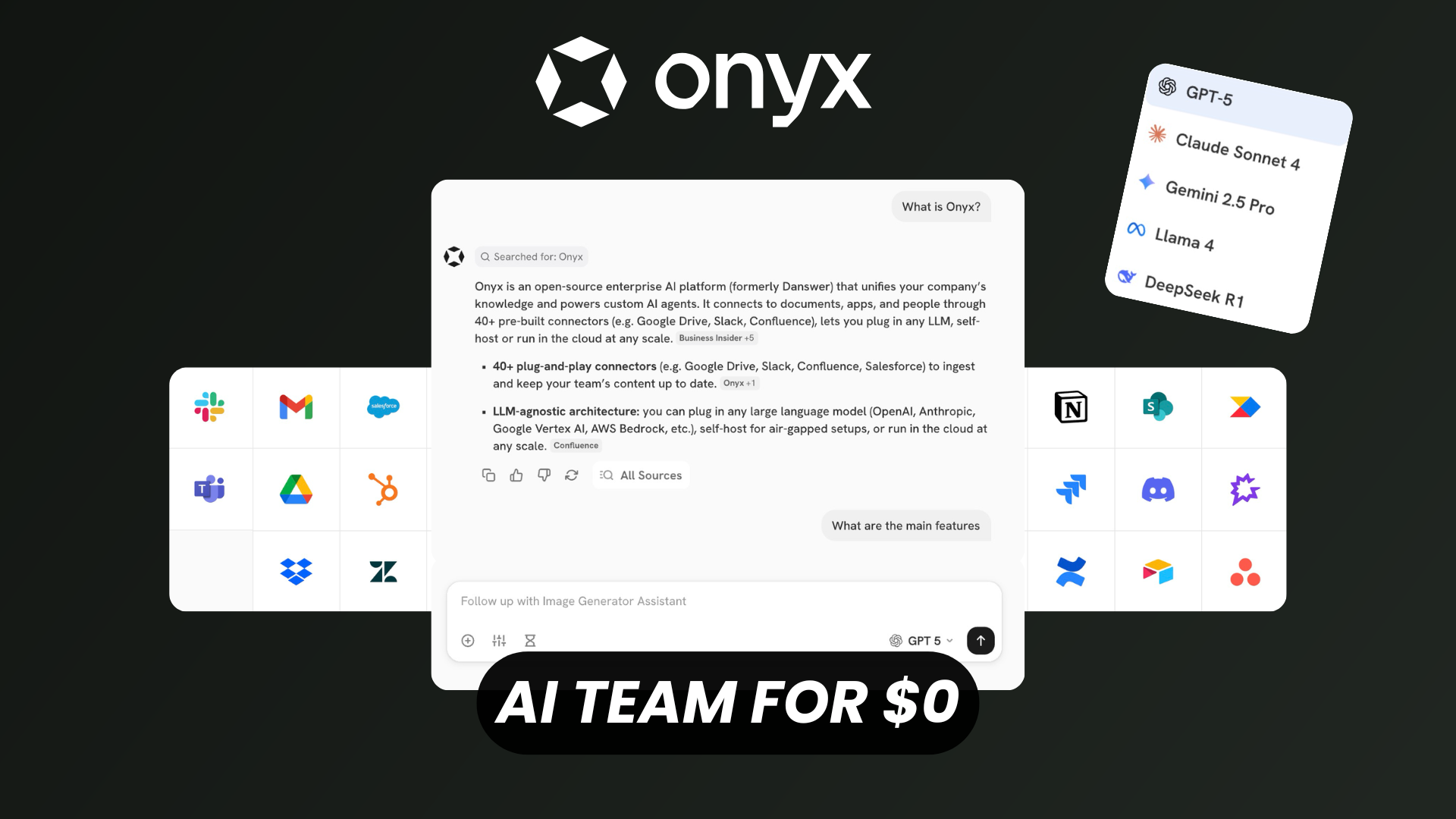
Onyx is an open-source platform designed to solve exactly that problem. It provides a unified interface to interact with LLMs, connect company data sources, build AI agents, and expose everything through APIs, all while remaining fully self-hostable.
Rather than being just another chat UI, Onyx acts as an application layer for AI, combining search, retrieval, orchestration, and automation into a single extensible system.
In this post, we’ll explore how Onyx works and what makes it one of the most complete open-source AI platforms available today.
Watch our platform overview video
LLMs, Search Engine, & Web Crawler
At its core, Onyx is designed to sit between your data and your language model.
It supports multiple LLM providers — including hosted APIs and local models — allowing you to swap models without rewriting your stack. This model-agnostic architecture is critical for teams that want to avoid vendor lock-in or optimize for cost and performance.
But raw LLM access is rarely enough. Onyx enhances responses using:
- Hybrid search across internal documents
- Retrieval-Augmented Generation (RAG)
- A built-in web search and crawler
- Contextual ranking and query expansion
This means when you ask a question, Onyx doesn’t just rely on the model’s training data — it actively retrieves and grounds responses in real-time information and internal knowledge.
The result is dramatically more accurate and auditable answers compared to vanilla chat interfaces.
Image Generation
Beyond text, Onyx also supports image generation through integrations with popular image models. This allows teams to use the same platform for:
- content generation
- marketing asset creation
- design ideation
- documentation visuals
Since image generation is implemented as a tool within the platform, it can also be invoked by agents — enabling fully automated creative workflows.
Team Members
Onyx is built to be used collaboratively, not just as a personal AI assistant. The platform includes built-in support for inviting team members and managing access across an organization.
Administrators can add users directly to the workspace, assign roles, and control what data or tools each person can access. This ensures that sensitive company knowledge remains protected while still allowing teams to benefit from shared AI capabilities.
Once invited, team members can:
- use the chat interface with access to shared knowledge sources
- collaborate on agents and assistants
- reuse prompts, workflows, and generated outputs
- and contribute new data through connected integrations
This collaborative model turns Onyx into more than a tool — it becomes a central AI workspace where teams can collectively build, refine, and operationalize AI workflows while maintaining clear permission boundaries and auditability.
Self-hosted LLM Chat Interface
One of the most visible parts of Onyx is its chat interface, which serves as the primary interaction layer for users.
Unlike lightweight chat UIs, Onyx’s interface is deeply integrated with:
- knowledge retrieval
- tool calling
- agent orchestration
- conversation sharing and analytics
The UI supports enterprise-grade features such as role-based access control and auditability, making it suitable for internal deployments where compliance and traceability matter.
Because it is fully self-hostable, organizations can deploy Onyx in air-gapped or private cloud environments while still benefiting from modern AI capabilities.
Integrations with Connectors
A key differentiator of Onyx is its connector ecosystem.
Connectors allow the platform to ingest and sync data from a wide range of tools such as:
- Google Drive
- Slack
- GitHub
- Notion
- Confluence
- and many others
These connectors continuously synchronize content and respect existing permissions, ensuring users only see the data they are authorized to access.
This capability transforms Onyx from a chatbot into an enterprise search engine and knowledge assistant that understands the full context of your organization.
Knowledge Base
All ingested data is indexed and stored in a structured knowledge base, which forms the backbone of Onyx’s retrieval system.
The knowledge base combines:
- vector embeddings for semantic search
- keyword search for exact matches
- metadata and access controls
- automatic document chunking and versioning
This hybrid architecture allows Onyx to deliver both precise and semantically relevant results — a critical requirement for enterprise use cases where accuracy and traceability are essential.
By maintaining this structured knowledge layer, Onyx enables features like:
- contextual answers
- document citations
- historical knowledge retention
- organization-wide search
Agents, Assistants, Bots, & MCP
Onyx includes a built-in framework for creating AI agents and assistants tailored to specific workflows.
Agents can be configured with:
- custom system prompts
- access to specific knowledge sources
- tool usage permissions
- automated actions across external services
One particularly notable feature is support for the Model Context Protocol (MCP). Through MCP, external AI tools such as Claude Desktop or developer IDEs can directly access Onyx’s knowledge base and tools.
This effectively turns Onyx into a centralized AI middleware layer that connects models, tools, and data across your ecosystem.
API
In addition to the web interface, Onyx exposes a comprehensive API that allows developers to:
- send chat queries programmatically
- retrieve knowledge search results
- manage agents and assistants
- integrate AI into existing applications
This API-first approach ensures that Onyx can serve as the backend for custom AI products, not just an internal tool.
It also allows teams to build:
- internal copilots
- customer-facing AI chatbots
- automated document processing pipelines
all powered by the same unified knowledge and agent infrastructure.
Conclusion
Onyx represents a shift in how organizations adopt AI. Instead of stitching together separate tools for chat, search, automation, and integrations, it provides a single open-source platform that unifies all of these capabilities.
By combining:
- self-hosted deployment
- multi-LLM support
- connectors to real company data
- built-in agents and APIs
Onyx positions itself as a serious alternative to proprietary enterprise AI platforms.
For teams concerned about privacy, extensibility, or vendor lock-in, it offers a compelling path toward building AI-native workflows while retaining full control over their infrastructure.