
OpenClaw: Free Open-Source AI Agent Running 24/7 on Your Server

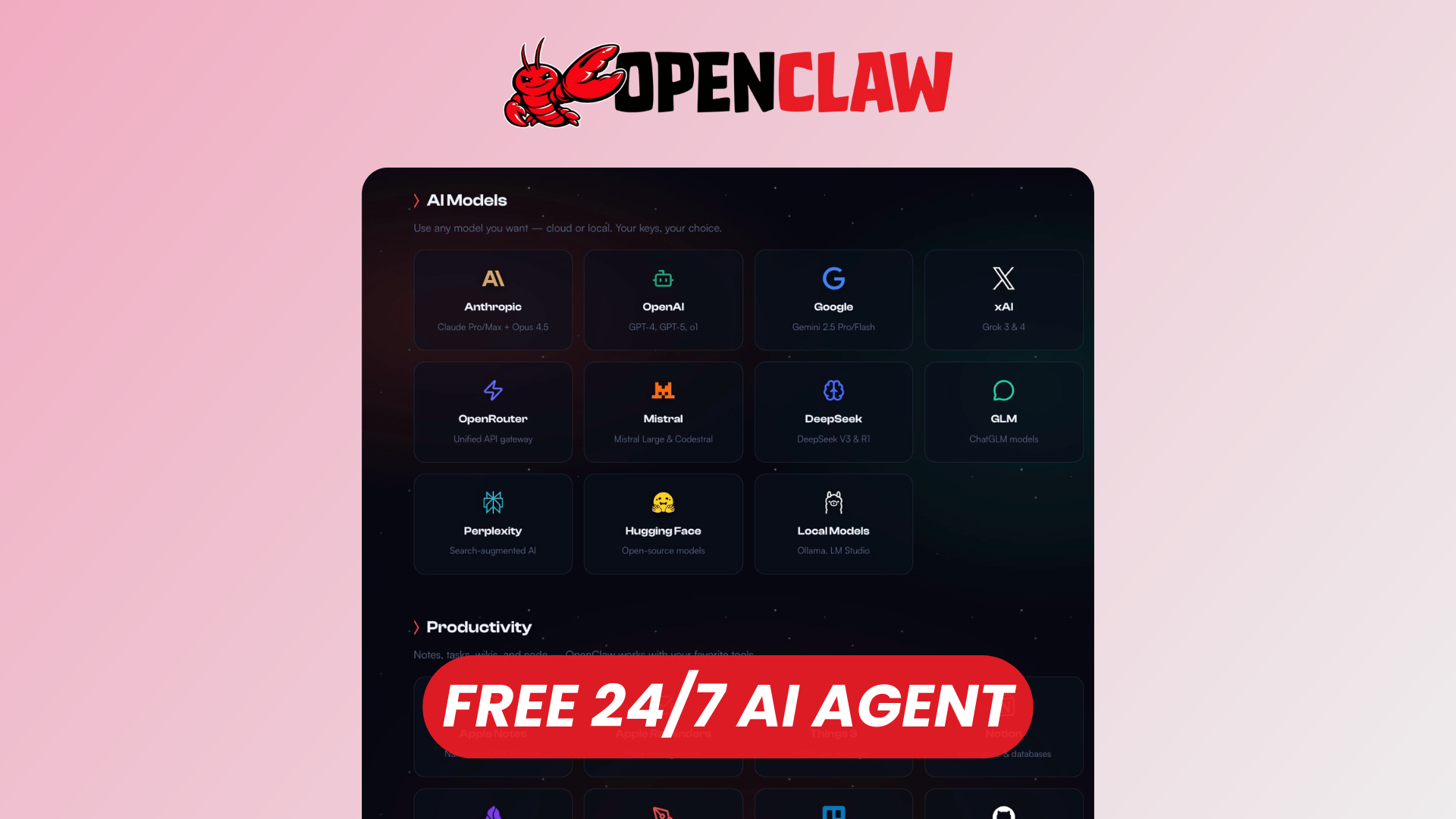
AI agents are moving from experiments to real infrastructure. Instead of chatbots that respond only when prompted, teams now want autonomous agents that run continuously, execute tasks, remember context, and communicate across platforms.
OpenClaw is an open-source AI agent framework designed exactly for that purpose.
OpenClaw runs on your own server, works around the clock, and gives you full control over agent behavior, data, and integrations. Whether you want a personal automation assistant or a production-grade AI workforce, OpenClaw provides the foundation without locking you into a closed ecosystem.
Watch our installation guide and platform overview
Onboarding Setup
Getting started with OpenClaw is straightforward. Since it is self-hosted, you install it directly on your server or VPS. The setup process guides you through environment configuration, model selection, and initial credentials.
Once installed, OpenClaw runs as a persistent service, meaning your agents stay alive even when you are offline. This makes it suitable for long-running workflows, background monitoring, and scheduled automation without relying on third-party uptime.
Open Claw UI
OpenClaw comes with a clean web interface that acts as the control center for your agents. From the dashboard, you can see agent status, recent activity, memory usage, and task execution history.
The UI is designed for clarity rather than complexity. You can create agents, assign skills, configure schedules, and monitor behavior without digging through configuration files. This makes OpenClaw accessible to both developers and non-technical users.
Agent Creation & Personality
One of OpenClaw’s strengths is how it handles agent identity. When creating an agent, you define its role, objectives, and personality traits. This goes beyond simple system prompts.
You can shape how an agent thinks, responds, prioritizes tasks, and interacts with users. For example, you can create a concise operations agent, a friendly community assistant, or a highly analytical research agent. Each agent operates independently with its own memory and skill set.
Communication Channels
OpenClaw agents are not limited to a single interface. They can communicate through multiple channels, allowing them to act where you already work.
Agents can receive instructions, send updates, and respond to events across supported platforms. This flexibility makes it easy to embed AI into existing workflows instead of forcing users into a new tool.
Telegram Bot
One of the most popular integrations is the Telegram bot. With minimal setup, your OpenClaw agents can send messages, receive commands, and provide real-time updates directly in Telegram.
This is especially useful for monitoring tasks, receiving alerts, or interacting with agents on the go. Telegram becomes a lightweight control panel for your AI agents, available from any device.
Autopilot Tasks (Cron jobs)
OpenClaw supports autonomous task execution through scheduled jobs. Using cron-style scheduling, agents can run tasks at specific times or intervals without human intervention.
These autopilot tasks can include data checks, report generation, reminders, system monitoring, or any custom workflow you define. Because the agent runs continuously, it can react to results, log outcomes, and trigger follow-up actions automatically.
Skills
Skills are modular capabilities that extend what an agent can do. A skill might be API access, file manipulation, web scraping, database queries, or custom business logic.
You can attach different skills to different agents, keeping responsibilities clearly separated. This modular design makes OpenClaw flexible and extensible, allowing you to grow agent capabilities over time without rewriting core logic.
Long Term Memory
Unlike stateless chatbots, OpenClaw agents can retain long-term memory. This allows them to remember past interactions, decisions, and relevant context across sessions.
Long-term memory enables more coherent behavior, better personalization, and true continuity. An agent can learn preferences, recall previous tasks, and build on prior knowledge instead of starting from zero every time.
Agents Manager
As your system grows, managing multiple agents becomes essential. OpenClaw includes an agents manager that gives you a centralized view of all active agents.
From here, you can start or stop agents, update configurations, monitor workloads, and debug issues. This makes OpenClaw suitable not only for single-agent use but also for orchestrating teams of specialized agents working together.
Conclusion
OpenClaw offers a powerful alternative to closed AI platforms by putting control back in your hands. With self-hosting, continuous operation, customizable agents, and rich integrations, it turns AI agents into reliable infrastructure rather than temporary tools.
If you are looking for a free, open-source AI agent that runs 24/7 on your server and adapts to your workflows, OpenClaw is a compelling foundation to build on.