
Why Graph Databases Are the Secret Weapon Behind Fraud Detection, Recommendations, and AI

Your business runs on relationships. Customers connect to products. Products connect to suppliers. Employees connect to departments. Transactions connect buyers and sellers. Every meaningful decision you make depends on understanding how things relate to each other.
And yet, most companies store all of this in spreadsheets and relational databases that were designed in the 1970s to handle rows and columns, not connections.
That's where graph databases come in. And Neo4j, the most widely adopted graph database in the world, is quietly powering some of the most critical systems behind fraud detection, personalized recommendations, and AI-driven insights.
What Exactly Is a Graph Database?
Think of it this way: a traditional database stores data in tables, like an Excel spreadsheet. If you want to find how Customer A relates to Product B through Supplier C, you need to "join" multiple tables together. The more connections you need to trace, the slower and more complex it gets.
A graph database stores data as nodes (things) and relationships (how things connect). Instead of joining tables, it follows direct links between data points. It's the difference between looking up a phone number in a printed directory versus just calling the contact saved in your phone.
Neo4j makes this intuitive. You model your data the way you actually think about it: people know other people, products belong to categories, transactions flow between accounts.
Why Businesses Are Paying Attention in 2026
Graph databases aren't new, but three trends are driving massive adoption right now.
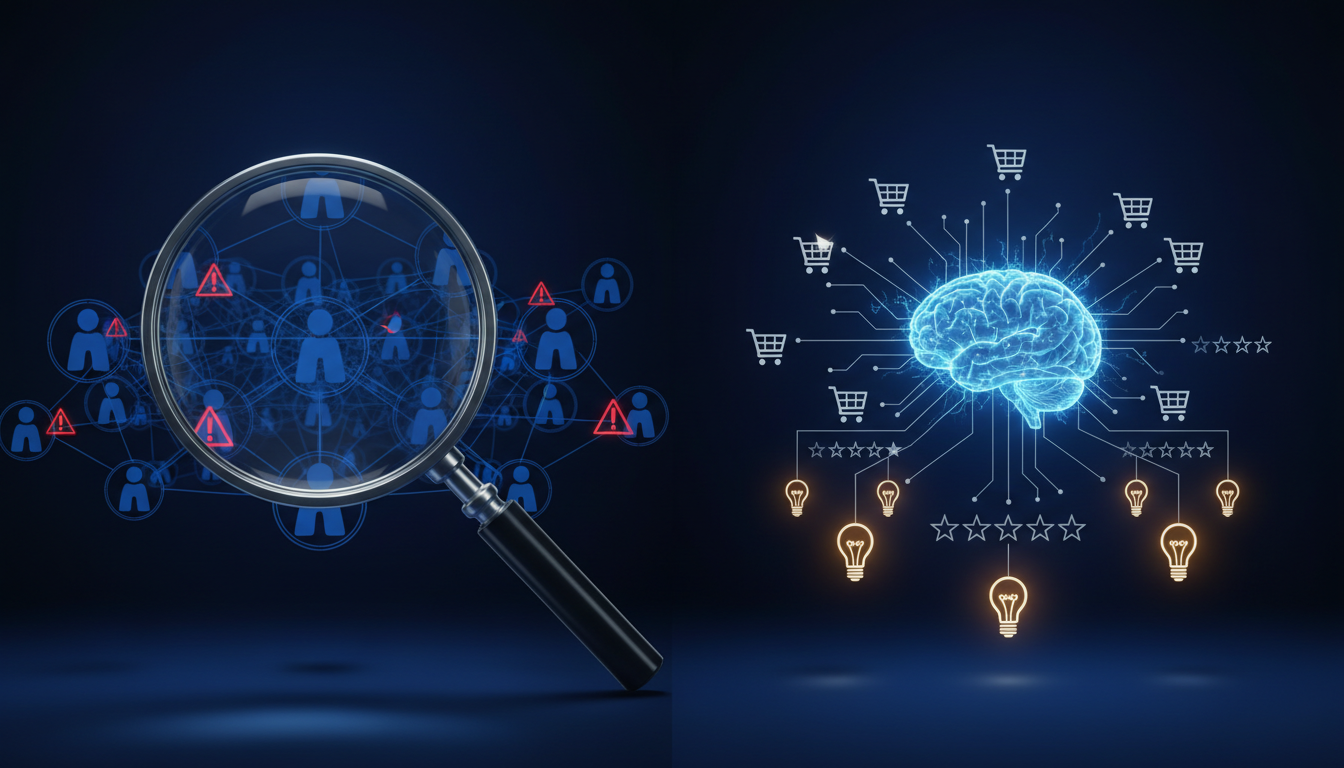
Fraud detection has become a graph problem. Fraudsters don't work alone anymore. They build networks of fake accounts, shell companies, and coordinated transactions designed to look normal when examined individually. Traditional databases see each transaction in isolation. Neo4j sees the entire web, catching fraud rings that would be invisible otherwise. Companies like PayPal and Zurich Insurance already use Neo4j for exactly this, with some reporting a 200% increase in fraud detection rates.
Recommendation engines need context, not just history. Netflix doesn't just recommend movies you've watched before. It analyzes how you watch (duration, time of day, device), what similar users enjoy, and how genres and actors connect. That's a graph problem. Any e-commerce platform, content service, or marketplace can use the same approach to deliver recommendations that actually feel personal.
AI needs structured knowledge to stop hallucinating. Large language models are powerful, but they make things up. Knowledge graphs built on Neo4j give AI systems a structured, verified source of truth to draw from. This combination of LLMs with graph-based knowledge, often called GraphRAG, is becoming the standard architecture for enterprise AI applications that need to be accurate.
Real Use Cases (Beyond Tech Giants)
You don't need to be Netflix or PayPal to benefit from graph databases. Here are practical scenarios for businesses of all sizes:
| Use Case | What It Solves | Who Benefits |
|---|---|---|
| Fraud detection | Identifies coordinated fraud rings by tracing transaction networks | Financial services, e-commerce, insurance |
| Recommendation engines | Delivers personalized suggestions based on relationships, not just purchase history | Retail, media, marketplaces |
| Supply chain mapping | Visualizes multi-tier supplier dependencies and identifies single points of failure | Manufacturing, logistics, retail |
| Customer 360 | Unifies customer data across touchpoints into a single connected view | Sales teams, marketing, support |
| Knowledge management | Maps organizational expertise, documents, and projects | Any company with 50+ employees |
| Network and IT management | Maps infrastructure dependencies and identifies failure cascades | IT teams, MSPs, telecoms |
The Performance Gap Is Real
When your data is deeply connected, the performance difference between a relational database and Neo4j isn't marginal. Research shows that Neo4j outperforms relational databases on pattern matching and recursive queries by significant margins. As datasets grow, relational databases slow down dramatically on relationship queries, while Neo4j performance stays nearly constant.
For a real-world example: a fraud detection query that traces relationships across five levels of connections might take minutes in a relational database (requiring multiple expensive JOINs). In Neo4j, the same query runs in milliseconds.
What About Cost?
Neo4j Community Edition is open-source, meaning no license fees and no per-user pricing. What you do need is infrastructure to host it.
On Elestio, you can deploy a fully managed Neo4j instance starting at around $29/month (4 CPU, 8 GB RAM on Netcup). That gives you automated backups, security updates, SSL certificates, and monitoring included. Compare that to Neo4j's own managed cloud service (Aura), which charges based on consumption and can quickly reach hundreds of dollars per month for production workloads.
| Expense | Neo4j Aura (Managed Cloud) | Self-Hosted (Elestio) |
|---|---|---|
| License | Consumption-based | No license fees (open-source) |
| Infrastructure | Included in price | $29/mo (Elestio, 4 CPU / 8 GB) |
| Backups & Monitoring | Included | Included |
| Estimated Monthly | $100-500+ | $29/mo |
| Annual Savings | - | $850-5,600+ |
For small and mid-sized businesses, self-hosting Neo4j is the clear value play.
Is a Graph Database Right for You?
Not every problem is a graph problem. If your data is mostly tabular and your queries are simple lookups or aggregations, a relational database like PostgreSQL is perfectly fine. Graph databases shine when:
- Your data has many-to-many relationships
- You need to traverse connections (friend-of-a-friend, supply chain tiers, transaction chains)
- You want real-time pattern detection (fraud, anomalies, recommendations)
- Your AI applications need structured knowledge
If you checked even one of those boxes, Neo4j is worth exploring.
Getting Started
The fastest way to try Neo4j without managing infrastructure is to deploy it on Elestio. You'll have a running instance with the browser-based Neo4j dashboard, ready to load data and run your first Cypher queries. No Docker expertise required, no server configuration, just a working graph database in a few clicks.
Start with a small proof of concept. Pick one dataset where relationships matter (customer transactions, product catalogs, organizational hierarchies) and model it as a graph. You'll likely be surprised how much insight emerges when you stop thinking in rows and start thinking in connections.
Thanks for reading! See you in the next one.